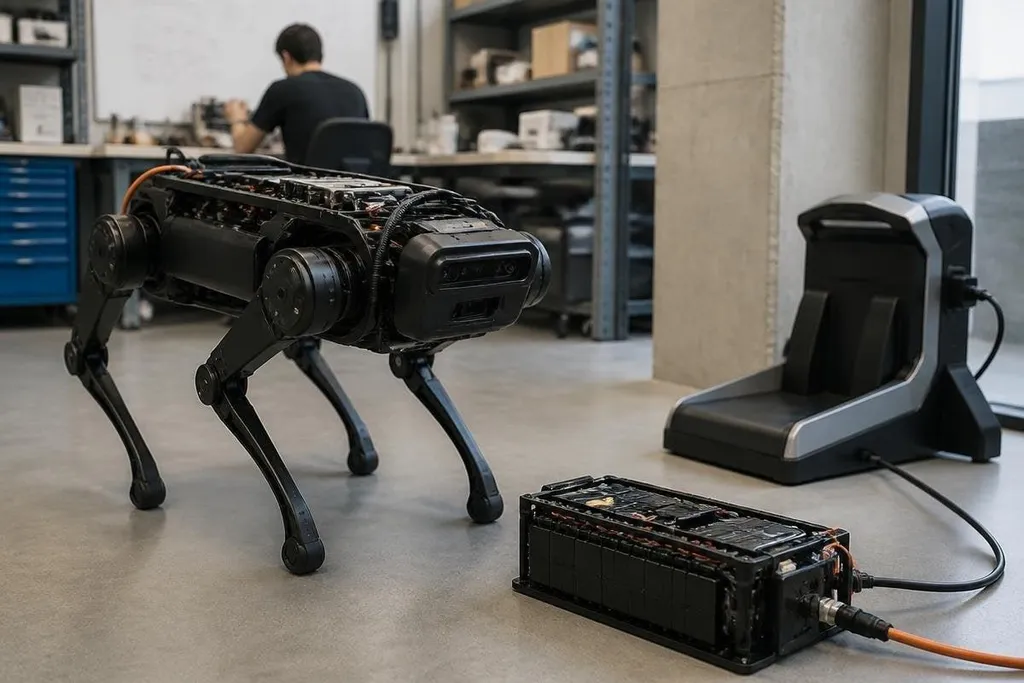
A robot can have strong motors and good software, then stop because its battery, wiring, or cooling system cannot keep up. The next gains in mobile robots will come from managing power across the whole machine, from the cell pack to the motor controller and the charging dock.
- Battery size affects runtime, weight, and balance at the same time.
- Heat limits how long motors can work at high load.
- Fast charging helps only when the pack, charger, and site can handle it.
The battery sets the basic trade-off
Most mobile robots use lithium-ion battery packs because they store much more energy by weight than older rechargeable chemistries. The pack still adds mass, and that mass raises the energy needed to move the robot, especially on legs or rough ground.
A larger pack can extend operating time, but it can also reduce payload. A warehouse robot may carry less stock after gaining a heavier battery. A legged robot faces another cost: each step needs the motors to lift and control more mass.
The battery management system, or BMS, checks cell voltage, current, and temperature. It also limits charging and discharge when conditions become unsafe. That control matters because cells in one pack do not age at the same rate, so the weakest cell can limit the whole pack.
Energy density and power density solve different problems. Energy density affects how long the robot can run. Power density affects whether the pack can send enough current during a lift, climb, or quick change in direction.
Motors turn stored energy into heat
A motor does not turn all electrical energy into motion. Some energy becomes heat in the windings, bearings, power electronics, and gearbox. As temperature rises, the controller may reduce current to protect the parts.
That limit can appear before the battery is empty. A robot may return to its dock with charge left because its motors or motor controllers reached their temperature limit. For a working machine, the useful question is not only how many watt-hours the pack stores. It is how much work the robot can repeat before heat changes its behavior.
Power electronics sit between the battery and the motors. In a legged robot, each motor controller must react to fast changes in torque, the turning force at the shaft. Poor control or undersized wiring can waste energy as heat and cause voltage drops during hard movement.
Cooling adds its own cost. Fans use power and pull dust through the housing. Liquid cooling can move heat away from motors and controllers, but it adds pumps, tubing, seals, and service points. The right choice depends on the robot’s duty cycle, enclosure, and working site.
Charging becomes part of the robot
A robot that works in a warehouse, field, or hospital needs a plan for charging. A plug-in dock may cost less to build, while battery swapping can keep a robot working when a long charge would interrupt a shift. Both methods need accurate docking, electrical protection, and checks for pack temperature.
Regenerative braking can send some energy back to the battery when a robot slows down or lowers a load. The gain depends on the motion pattern and the battery’s ability to accept current. A robot that spends most of its time lifting may have a different power profile from one that drives across flat floors.
A battery rating means little without the robot’s task, charge time, peak load, and duty cycle. Reporting from Robot24.com can put those figures beside a named machine and test date, so you can judge whether a proposed power system fits the work. That evidence points to the next issue: which changes engineers can make without adding weight or cost.
What engineers will change next
Future robot packs may use improved lithium-ion cells, new solid-state designs, or different chemistries for safer stationary storage. Those options still need testing in real duty cycles. A lab result on a cell does not prove that a complete pack will survive vibration, dust, repeated fast charging, and years of service.
Software will also shape power use. A controller can reduce current during low-load movement, plan smoother paths, and limit peak torque when the task allows it. That work saves energy only when the robot still meets its speed, balance, and payload needs.
I'd put thermal control ahead of a larger battery for most working robots. Extra stored energy helps on paper, but heat decides whether the robot can repeat the job.
A practical buying checklist
Before choosing a robot power system, check:
- Work cycle: measure driving, lifting, waiting, and idle time across a full shift.
- Peak current: ask for the pack and controller limits during the hardest movement.
- Heat limits: find out when the robot reduces motor power and how it cools itself.
- Charging plan: confirm charge time, dock space, electrical supply, and pack-swap rules.
- Service access: check whether technicians can replace cells, fuses, fans, and connectors.
- Proof under load: ask for results from the full robot, not from a battery cell alone.
The best power system will depend on the job, the floor, the load, and the hours between charges. Until makers publish full duty-cycle data, the useful figure is the number of completed work cycles before the robot slows, stops, or needs service.